
Don Quijote y el Astrolabio / Don Quixote and the Astrolabe
Por Roland Müller
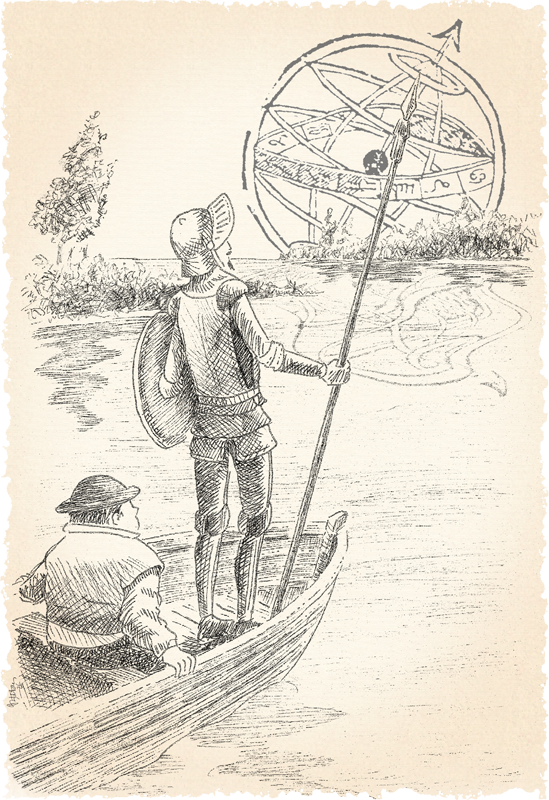
It happened in the 29th chapter of the 2nd part of Miguel de Cervantes’ famous book. Don Quixote desperately shouted: „If I only had an astrolabe!” Now the author could have caused Sancho Pansa to ask “What is an astrolabe?” Then Don Quixote might have told the following story. But Miguel de Cervantes decided to continue otherwise. Thus, the story is given only here:
Hundreds of years ago, when ships from Iberian harbours dominated the Atlantic Ocean and the Mediterranean Sea, their crews were often in danger of being attacked by well-equipped pirates. One day a ship owned by a rich Andalusian merchant fell victim to such pirates. Its goods were transferred to the pirate ship and the whole crew imprisoned in order to make a good ransom deal later on.
Looking over his captives, the pirate captain perceived something that was strange to him. “What is it that you are carrying around your neck?” he asked the raided ship’s navigator. “This is my astrolabe” said the navigator, Miguel by name. “Explain it!” ordered the pirate. And Miguel explained:
“This astrolabe was made by Muhammad Ibn al-Saffar of Cordoba, at his time the best maker of astrolabes in whole Andalusia and far beyond. It can help to measure heights, distances, directions, calendar dates, and times of day and night.” “Show me!” the pirate demanded further. So, in the following days and nights the captured navigator showed every piece and detail of his instrument. He demonstrated how to rotate the so-called rete with star pointers across a network of curved lines in the disk surface beneath. Miguel called these lines almucantar and azimuth. On the astrolabe’s backside he explained the alidade, a sight bar to aim at the altitude of stars and sun above the horizon, which is also essential for reading the hour of day and night.
The pirate captain learned quickly. After a few days, he could operate the astrolabe himself. But he kept Miguel always nearby, to get instant advice when needed. One morning, the horizon showed signs of land far away. The captain called for the astrolabe to determine where they were on the sea around them and what the horizon’s skyline might be. From the astrolabe’s answer he inferred that the land ahead was part of their homeland. “Straight forward!” he ordered, and the ship kept course towards there.
Miguel, however, just before handing the astrolabe to the captain, had exchanged therein the disks with the curved lines, the tympans. This had altered the result of determining the altitude of sun and stars at given latitudes of the globe. Therefore, instead of sailing home, the ship got into a group of unknown isles with shallow water in between. When the captain noticed the failure, it was too late. Suddenly the ship turned over, severely damaged by rocks underneath. At the same time, a ship of the king’s armada showed up from behind the next isle. Rumbling of guns forced the pirates to give up. All prisoners were released.
When the warship’s commander was told how the pirate captain had got fooled by Miguel’s tricky intervening into the astrolabe’s functions, he informed his admiral. The admiral reported it to the king. And the king himself rewarded Miguel with a golden medal as big as his astrolabe was.
This ends the story. However, courageous readers are cordially invited to now look into chapter 29 of the 2nd part of Miguel de Cervantes’ famous book. Meet Don Quixote and Sancho Pansa there! Enter their magic boat for an adventurous trip on river Ebro. Become aware of sky pole, ecliptic, equinox, solstice, Ptolemais, colure stars, zodiac, and planets. Finally, get back to the shore – and survive. Good luck!
Roland Müller, 2026
.
Ocurrió en el capítulo 29 de la segunda parte del famoso libro de Miguel de Cervantes. Don Quijote gritó desesperado: «¡Si tuviera un astrolabio!». El autor podría haber provocado que Sancho Panza preguntara: «¿Qué es un astrolabio?». Entonces Don Quijote podría haber contado la siguiente historia. Pero Miguel de Cervantes decidió continuar de otra manera. Por lo tanto, la historia se relata solo aquí:
Hace cientos de años, cuando los barcos de los puertos ibéricos dominaban el océano Atlántico y el mar Mediterráneo, sus tripulaciones corrían a menudo el peligro de ser atacadas por piratas bien equipados. Un día, un barco propiedad de un rico comerciante andaluz cayó víctima de estos piratas. Sus mercancías fueron transferidas al barco pirata y toda la tripulación encarcelada para luego negociar un buen rescate.
Al observar a sus cautivos, el capitán pirata observó algo que le pareció extraño. «¿Qué llevas al cuello?», le preguntó al navegante del barco asaltado. «Este es mi astrolabio», dijo el navegante, llamado Miguel. «¡Explícalo!», ordenó el pirata. Y Miguel explicó:
“Este astrolabio fue fabricado por Muhammad Ibn al-Saffar de Córdoba, en su época el mejor fabricante de astrolabios de todo al-Andalus y mucho más allá. Sirve para medir alturas, distancias, direcciones, fechas del calendario y horas del día y de la noche”. «¡Muéstrame!», exigió el pirata. Así, durante los días y noches siguientes, el navegante capturado mostró cada pieza y detalle de su instrumento. Demostró cómo girar la llamada rete con indicadores estelares a lo largo de una red de líneas curvas en la superficie del disco inferior. Miguel llamó a estas líneas almicantarat y azimut. En el reverso del astrolabio explicó la alidada, una regla móvil equipada con dos pínulas para medir la altura de las estrellas y el sol sobre el horizonte, que también es esencial para leer la hora del día y de la noche.
El capitán pirata aprendió rápido. Después de unos días, podía manejar el astrolabio él mismo. Pero siempre mantenía a Miguel cerca para que le aconsejara al instante cuando lo necesitara. Una mañana, el horizonte mostró señales de tierra a lo lejos. El capitán pidió el astrolabio para determinar dónde se encontraban en el mar que los rodeaba y cómo podría ser el horizonte. Por la respuesta del astrolabio, dedujo que la tierra que tenían delante formaba parte de su tierra natal. «¡Directo!», ordenó, y el barco mantuvo rumbo hacia allí.
Sin embargo, Miguel, justo antes de entregarle el astrolabio al capitán, había intercambiado los discos por las líneas curvas, los tímpanos. Esto había alterado el resultado de la determinación de la altitud del sol y las estrellas en determinadas latitudes del globo. Por lo tanto, en lugar de navegar de vuelta a casa, el barco entró en un grupo de islas desconocidas con aguas poco profundas. Cuando el capitán notó el fallo, ya era demasiado tarde. De repente, el barco volcó, gravemente dañado por las rocas que se encontraban debajo. Al mismo tiempo, un barco de la armada real apareció tras la siguiente isla. El estruendo de los cañones obligó a los piratas a rendirse. Todos los prisioneros fueron liberados.
Cuando el comandante del buque de guerra se enteró cómo el capitán pirata había sido engañado por la astuta intervención de Miguel en las funciones del astrolabio, informó a su almirante. El almirante se lo comunicó al rey. Y el propio rey premió a Miguel con una medalla de oro tan grande como su astrolabio.
Aquí termina la historia. Sin embargo, los lectores valientes están cordialmente invitados a leer el capítulo 29 de la segunda parte del famoso libro de Miguel de Cervantes. ¡Allí encontrarán a Don Quijote y Sancho Panza! Suban a su barca mágica en un aventurero viaje por el río Ebro. Conozcan el polo celeste, la eclíptica, el equinoccio, el solsticio, las ptolemaidas, las estrellas de los coluros, el zodíaco y los planetas. Finalmente, regresen a la orilla y sobrevivan. ¡Mucha suerte!
Roland Müller, 2026
.
Nuestro agradecimiento por esta colaboración al autor alemán Roland Müller, gran admirador de la obra de Miguel de Cervantes y de los astrolabios.
Puedes ver otra obra suya, El sueño de Sancho / Sancho’s Dream, en este mismo sitio
Blog de noticias
- Exposición en Antequera
 Exposición en Antequera 11/3/2025 Desde el 13 al 31 de marzo de 2026 se puede…
 - Invitación a la conferencia on line con motivo del WSD 2026
 La comunidad del Día Mundial de los Relojes de sol (WSD) te invita participar en…
 - Calendario gnomónico – Marzo 2026
 Calendario gnomónicoMarzo 2026 Fotografías de Vicente J. Fernández Gallego Descárgate gratuitamente el calendario gnomónico 2026…
 - En el Día de Andalucía
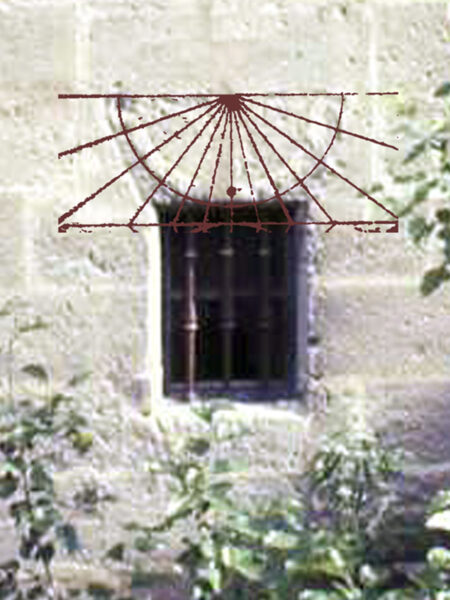 . En el Día de Andalucía Sobre la fachada manierista orientada exactamente al mediodía del…
 - Relojes de sol en memoriales, cementerios y tumbas
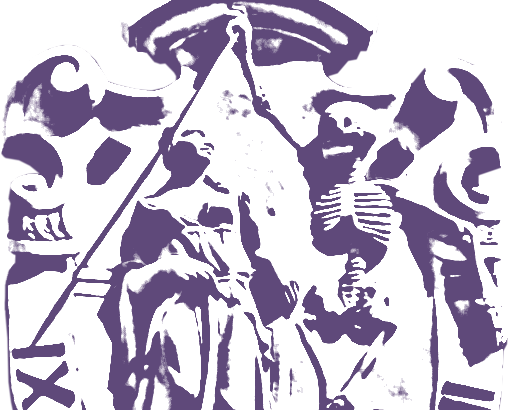 En este documento, acompañado de dibujos del autor, se nos relatan más de setenta muestras y vestigios andaluces de la secular medición del tiempo mediante la observación directa del firmamento, del movimiento de sus astros o del movimiento de sombras en accidentes geográficos según su denominación toponímica de raíz temporal.
 - Calendario gnomónico – Febrero 2026Calendario gnomónicoFebrero 2026 Fotografías de Vicente J. Fernández Gallego Descárgate gratuitamente el calendario gnomónico 2026…
Comparte esta noticia en redes sociales